
Phishing Email Malware Analysis
Phishing Email Malware Analysis
Phishing Email Malware
Analysis
This project involved analysing a suspicious executable file obtained from a phishing email to determine whether it was malicious and to extract indicators of compromise for threat detection.
This project involved analysing a suspicious executable file obtained from a phishing email to determine whether it was malicious and to extract indicators of compromise for threat detection.
CHALLENGES
CHALLENGES
A key challenge was that the file initially appeared legitimate and did not reveal obvious indicators such as URLs or IP addresses through basic string analysis. This required a deeper static analysis approach to understand the file’s structure and behaviour. Working within a Kali Linux virtual machine for safety, multiple tools and techniques had to be applied to thoroughly inspect the binary and uncover hidden characteristics.
A key challenge was that the file initially appeared legitimate and did not reveal obvious indicators such as URLs or IP addresses through basic string analysis. This required a deeper static analysis approach to understand the file’s structure and behaviour. Working within a Kali Linux virtual machine for safety, multiple tools and techniques had to be applied to thoroughly inspect the binary and uncover hidden characteristics.

RESULTS
RESULTS
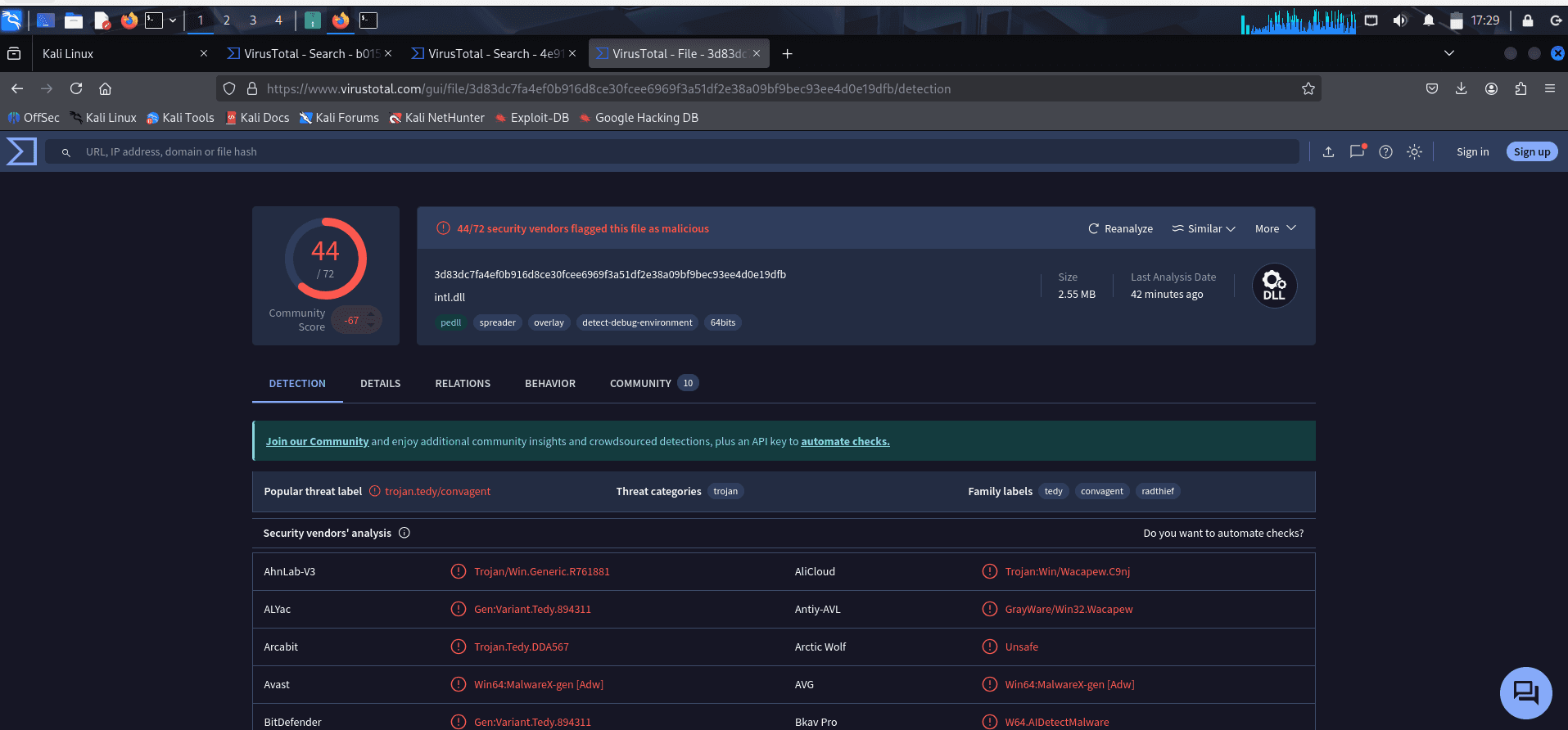
The analysis confirmed that the file was a malicious Windows Trojan, flagged by multiple security vendors. Through structured investigation, file hashes, metadata, imported API functions, and PE structure details were successfully extracted. Additional analysis using binwalk and threat intelligence platforms helped identify embedded or obfuscated data. Key indicators of compromise were documented to support future detection and response efforts. The project demonstrated practical skills in malware analysis, threat identification, and forensic investigation workflows used in Security Operations Centres.
Project Repository: https://github.com/Enowon/phishing-email-malware-analysis.git
The analysis confirmed that the file was a malicious Windows Trojan, flagged by multiple security vendors. Through structured investigation, file hashes, metadata, imported API functions, and PE structure details were successfully extracted. Additional analysis using binwalk and threat intelligence platforms helped identify embedded or obfuscated data. Key indicators of compromise were documented to support future detection and response efforts. The project demonstrated practical skills in malware analysis, threat identification, and forensic investigation workflows used in Security Operations Centres.
Project Repository: https://github.com/Enowon/phishing-email-malware-analysis.git

CONTACT
CONTACT
Reach out to discuss entry-level SOC roles, Internships, or cybersecurity collaborations
Reach out to discuss entry-level SOC roles, Internships, or cybersecurity collaborations
ceceenowon@gmail.com
ceceenowon@gmail.com
+44 7823 742289
+44 7823 742289
www.linkedin.com/in/faith-okonoboh
www.linkedin.com/in/faith-okonoboh
OKONOBOH
OKONOBOH
OKONOBOH